
Money is stored energy. You probably never thought about money this way, so let’s unpack it.
Imagine you spend your days digging ditches and at the end of the every week you receive your paycheck.
The energy you expended digging ditches, has been converted into money!
Hopefully, your earnings cover your expenses and also leave you some left over.
If you made $200 a day digging ditches, five days a week, you made $1,000 this week.

Suppose your rent, groceries and utilities come to $800 a week, that leaves you with $200.
What should you do with this $200? Remember, this $200 is your energy currently in the form of money.
You can exchange it for a dinner for two and theater tickets. Or you can save it, so that the $200 is available in the future to use for something else. Or, you can harness it to earn more money; meaning you can use this captured energy to capture more energy.
If you decide to save or invest it, you will want a vehicle that meets four criteria.
Four Criteria for A Savings/Investment Vehicle
- You want as little risk as possible to your principle. You don’t want your $200 to become $150, for example.
- You want your $200 to keep its purchasing power. Meaning, if it can buy dinner for two and theater tickets today, you want it to be able to buy the same in a year.
- Ideally, you want your $200 to grow in purchasing power – so that at the end of the year it’s purchasing power has increased. And now you can buy dinner for three and theater tickets.
- And ideally, you want to grow your principle, such that your $200 becomes $250, for example.
However, our financial system is intentionally designed such that if you put $200 under your mattress, it will lose some of its value every day. If you had put $200 under your mattress on January 1st, 2020, by September 1st, 2023, it would only buy you $162 worth of goods!

What causes this inflation?
The government prints more and more money so they can keep up their endless and reckless spending.
But every time the government prints another dollar, your share of the entire pie is diluted.
When prices go up, we call that “inflation,” But what’s really happening is that as the government prints more money, the purchasing power of all existing dollars, pounds or euros goes down.
To make matters worse, inflation is actually a wealth transfer from those with fewer assets to those with more assets.
That’s why when governments around the world printed trillions during covid and in the years afterwards, whose net-worth rose dramatically?
Exactly. The stock markets surged. Real estate surged. And the net-worth of people who owned those assets surged.
But regular people and small business owners saw the value of their savings go down while their cost of living went through the roof.
Even if you take government stats of 19% inflation from Jan 1st, 2020 through September 1st, 2023, how many people’s salaries grew by 19% during that time?
Very, very few.
The process of inflation transfers wealth from those with fewer assets to those with more assets. We will explain how this works in greater detail in a future article.
But the worst part is that all this is by design. It’s intentional.
If this all sounds a bit crazy and conspiratorial, all I ask is that you mull over the key points we’ve made so far in this series:
- Point 1: You would never choose to save your money in a vehicle that someone else can dilute for their own gain. We made that point here.
- Point 2: Money is a way to capture energy you expended so that you can preserve it for the future.
- Point 3: When you try to preserve your energy in dollars (or any other fiat currency) you need to run hard just to stay in place.
Why? Because a small group of people have the privilege of printing more dollars.
When they print, they get increased purchasing power, while your purchasing power drops.
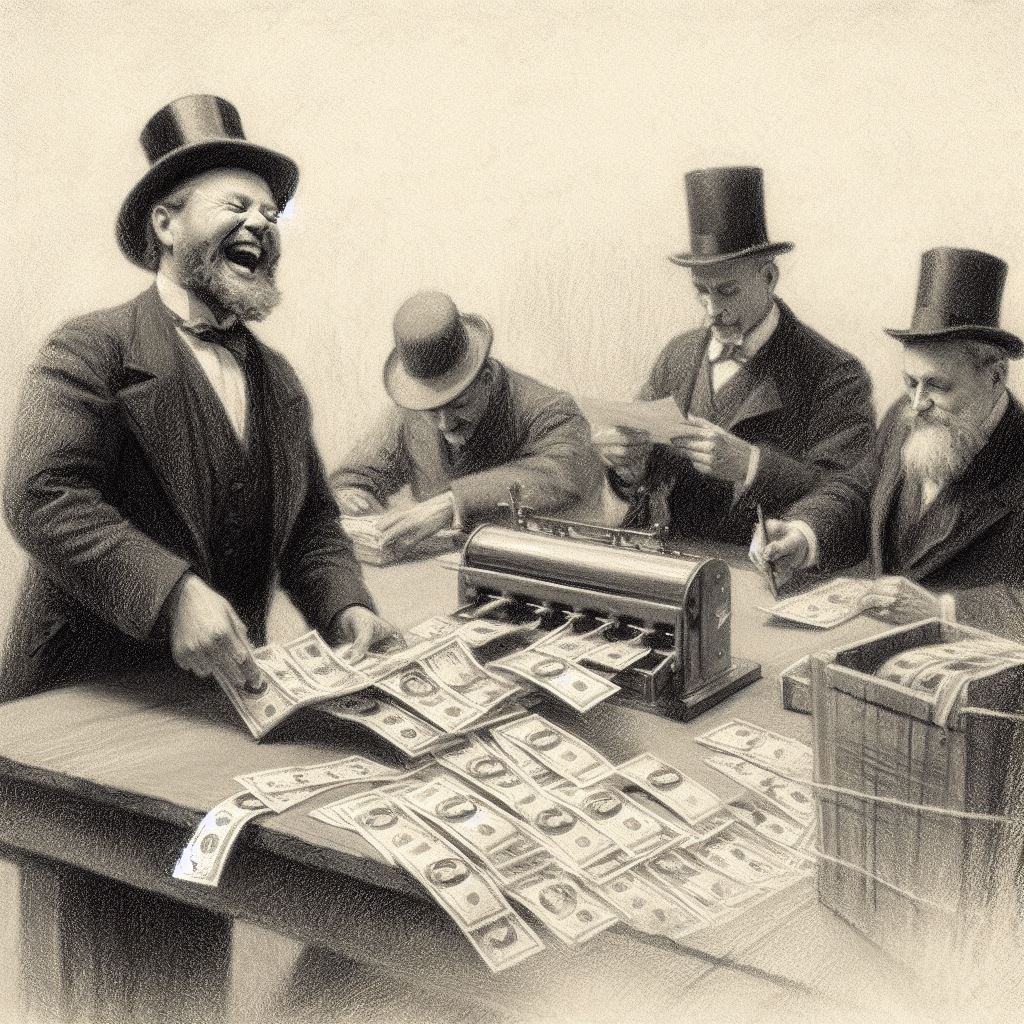
When you dig ditches five days a week, a portion of the energy you are expending is siphoned off by those who benefit from an expanding money supply.
With rampant inflation, we’re all feeling it more.
Wouldn’t you like a way out?!
For the first time in history, there is a way out.
It’s called Bitcoin.
Earlier we laid out Four Criteria for A Savings/Investment Vehicle.
In the next article, I’ll show you how Bitcoin does an outstanding job at satisfying these criteria, while the dollar and other fiat currency are designed to work against you at every step.
You’ll start to see how Bitcoin preserves your monetary energy in a way that frees you from inflation, gives you increased buying power.
And when you’re ready to buy your first $100 of Bitcoin, or $1,000 – or more, I recommend you buy from the people at Swan who will treat you as well as they’ve treated me.
—
Remember: nothing on this site is investment advice. While it is my personal opinion that everyone should own at least some Bitcoin, that is only my personal opinion.
You, of course, need to do your own research and consult with your own advisors until you make the right decision for you.
Click here to read the next article: How Bitcoin Frees You from Inflation.